In order for a living being to survive; their cells must go through a necessary process of replication and division. This process is called the cell cycle. The cell cycle is a multi-step cycle that includes the following phases: G1 phase, S phase, G2 phase, Mitosis, and cytokinesis. Since the cell cycle is necessary for survival it must be tightly regulated. If the cell cycle isn’t regulated properly, or if there are mutations in the DNA the cell can replicate and divide uncontrollably. This uncontrollable cell grow will lead to cancer. One of the key proteins that regulates the cell cycle is called p53. The damaged or mutated DNA that will lead to the erratic cell grow is halted by p53. The presence of p53 in the cell cycle of damaged DNA will lead to cell cycle arrest, DNA repair, or apoptosis. To initiate the cell cycle arrest in response to damage DNA; p53 binds to two sites that are upstream of the p21 promoter, which will cause the creation of the p21 protein. The p21 protein will eventually cause the cell cycle to arrest at the G1 phase by binding to the cyclin E/CDK2 complex. The cell cycle arrest is induce to provide time for DNA repairs, if the damage is minor. Another p53 induce gene, p53R2 is responsible for DNA repairs. Induction of p53 cause many genes that are involved in the apoptotic pathway to become active. Bnip3L, caspase6, Fas, Killer/Dr5, Puma, Noxa are just a few of the many genes p53 will induce to achieve apoptosis of a damage cell. The importance of a check and balance system in the cell cycle can’t be appreciated enough; without it humans and other species will cease to exist.
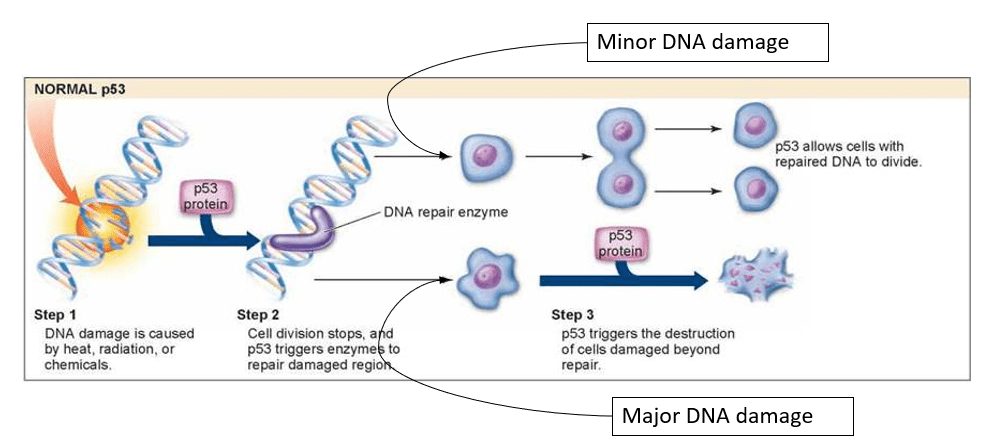
The image shows how p53 regulates the cell cycle when the DNA has minor and major damage.
Source:
References:
- Chen, Jiandong. “The Cell-Cycle Arrest And Apoptotic Functions Of P53 In Tumor Initiation And Progression”. Cold Spring Harbor Perspectives In Medicine, vol 6, no. 3, 2016, p. a026104. Cold Spring Harbor Laboratory, doi:10.1101/cshperspect.a026104.
- “Primary Information Of P53 Gene”. Bioinformatics.Org, 2020, http://www.bioinformatics.org/p53/introduction.html.
- “The Cell Cycle, Mitosis And Meiosis — University Of Leicester”. Www2.Le.Ac.Uk, 2020, https://www2.le.ac.uk/projects/vgec/highereducation/topics/cellcycle-mitosis-meiosis.
 Spring 2020 Cell Cycle and Cancer