DNA damage can come in many forms: from wide-scale deletions of genes to the smaller instances of base-pair substitutions. UV and IR radiation are typical causes of disruptions in DNA strands.
p53 is a protein that is sensitive to all forms of DNA damage.
ex. p53 is activated with only a single break in double stranded DNA, which is typically caused by IR radiation.
” p53 contributes to genome maintenance to a large part by allowing time for the DNA-repair machinery to remove the lesions before cell proliferation resume”
Williams, Ashley B, and Björn Schumacher. “p53 in the DNA-Damage-Repair Process.” Cold Spring Harbor perspectives in medicine vol. 6,5 a026070. 2 May. 2016, doi:10.1101/cshperspect.a026070
p53 can by modified by reduction-oxidation couple reactions. Oxidative stress can induce DNA damage so it is crucial that p53 is consistently in a reductive form.
When there is cell with DNA damage: p53 will increase transcription of group of repair genes termed BER (base excision repair). These genes include DNA polymerase, OGG1, and AP endonuclease. Then p53 will modulate these BER proteins activity in a dose-dependent scheme of DNA damage. Low amounts of DNA damage will increase BER activity. High amounts of DNA damage will decrease BER activivty and p53-induced cell apoptosis will occur.
p53 binds to BER and other downstream target genes at their consensus sequence (10 base pairs). Phosphorylation of p53 at S315 and S378 will encourage DNA binding. Then the p53 tetramer will form allosterically when S392 is phosphorylated and S315 is dephosphorlyated.
When there is cell without DNA damage: Another protein comes into play. Mdm2 is a regulator of p53. Mdm2 marks p53 for degradation by ubiquitin in the cytoplasm.
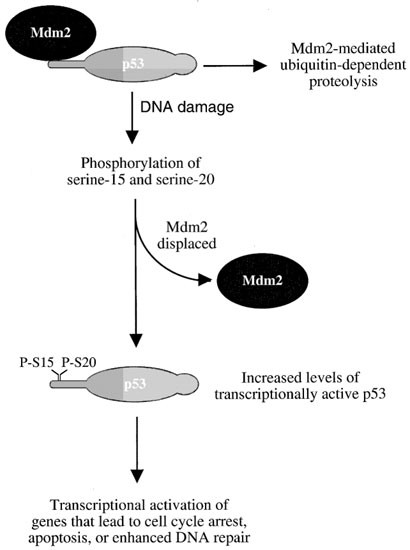
Source: Lakin, N., Jackson, S. Regulation of p53 in response to DNA damage. Oncogene 18, 7644–7655 (1999). https://doi.org/10.1038/sj.onc.1203015
References
- Lakin, N., Jackson, S. Regulation of p53 in response to DNA damage. Oncogene 18, 7644–7655 (1999). https://doi.org/10.1038/sj.onc.1203015
- Williams, Ashley B, and Björn Schumacher. “p53 in the DNA-Damage-Repair Process.” Cold Spring Harbor perspectives in medicine vol. 6,5 a026070. 2 May. 2016, doi:10.1101/cshperspect.a026070
- Yuangang Liu, Molly Kulesz-Martin, p53 protein at the hub of cellular DNA damage response pathways through sequence-specific and non-sequence-specific DNA binding, Carcinogenesis, Volume 22, Issue 6, June 2001, Pages 851–860, https://doi.org/10.1093/carcin/22.6.851
 Spring 2020 Cell Cycle and Cancer